


Multi-Car Pileups: How an Accident Lawyer Untangles Liability in Chain-Reaction Crashes
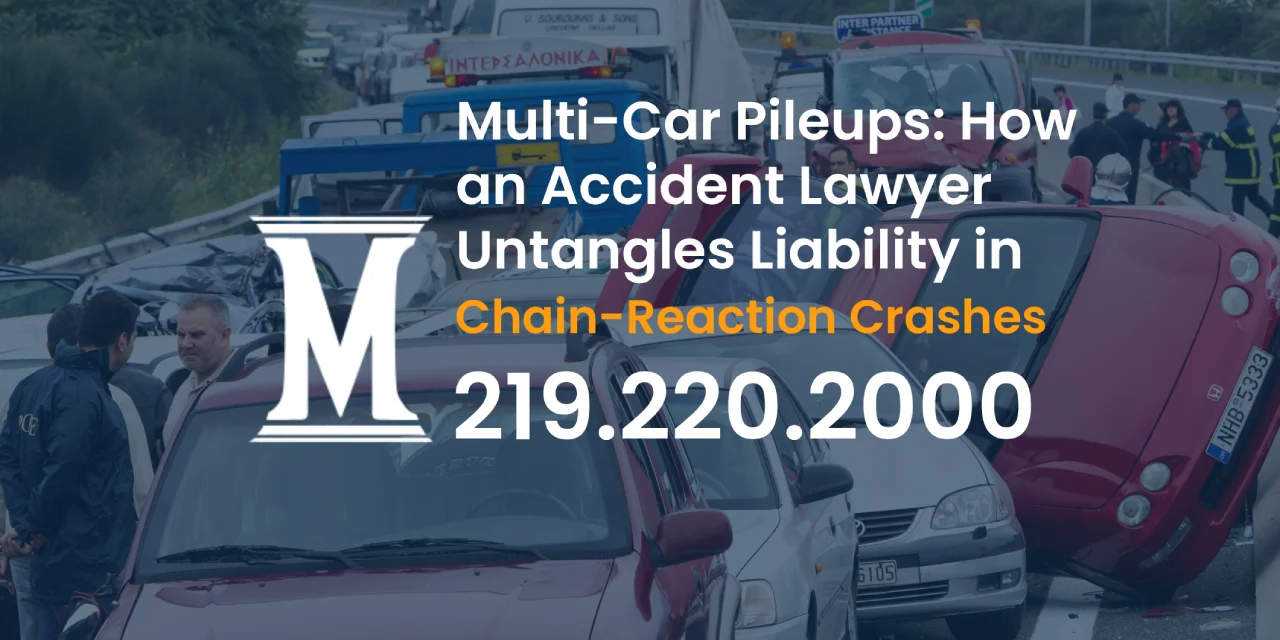
In a two-car accident, determining who caused it usually involves reviewing the evidence and following a clear chain of causation from one driver’s action to the other’s injury.
But in a multi-car pileup, that line does not exist.
There are three, four, sometimes ten vehicles involved, and the crash did not happen in one moment. It happened in a sequence, impact after impact, with each collision changing the physics for every vehicle behind it.
- The driver who caused the first impact may not be responsible for the injuries you sustained three collisions later.
- The driver who hit you may have been pushed into your vehicle by someone behind them.
- The person who appears most at fault based on vehicle position may actually have been a victim of the chain reaction rather than a cause of it.
Untangling this is what a car accident lawyer does when a pileup claim lands on their desk. And this blog explains the process. How the crash sequence is reconstructed, how fault is assigned across multiple drivers, and why the investigation matters more in pileup cases than in any other type of collision.
The Police Report Is the Starting Point, Not the Answer
After a multi-car pileup, the police report is the first document everyone looks at. It records the scene, the vehicle positions, the drivers’ statements, and any citations issued. It is an important reference, but it is rarely the final word on fault.
The responding officer did not witness the crash. They arrived after it happened and pieced together what they could from the aftermath. In a pileup involving five or six vehicles, the scene is chaotic. Vehicles may have been moved. Debris fields overlap. Drivers are shaken and their accounts are incomplete or contradictory.
A personal injury lawyer treats the police report as the starting point of the investigation, not the conclusion. The report tells them where to look, and a deeper investigation tells them what actually happened.
Reconstructing the Crash Sequence
Now this is the most critical step in any multi-car pileup case. The crash did not happen all at once. It unfolded in a sequence, and every vehicle in the chain entered that sequence at a different moment.
An accident reconstruction professional breaks the pileup into its individual collisions.
Impact one. Impact two. Impact three. Each one is analyzed separately to determine which driver’s actions caused it.
The Evidence They Use
- Vehicle damage patterns: The location, depth, and angle of damage on each vehicle reveal the direction the force came from and the severity of the impact. A rear-end impact produces a different damage signature than a sideswipe or a secondary push.
- Skid marks and road evidence: Tire marks on the road show where vehicles braked, swerved, or lost control. The length of a skid mark tells the reconstruction team how fast the vehicle was traveling before impact. The absence of skid marks may indicate the driver never braked at all.
- Event data recorder information: Most modern vehicles have a black box that records speed, braking input, throttle position, and seatbelt status in the seconds before a collision. This data is among the most objective evidence available because it captures what the vehicle was doing independent of what the driver remembers.
- Dashcam and traffic camera footage: Video from any vehicle in the chain, or from any nearby traffic or surveillance camera, can show the sequence in real time. This evidence is powerful because it removes the ambiguity that competing driver accounts create.
- Final resting positions: Where each vehicle ended up after the chain reaction provides clues about the sequence and severity of each impact.
That information is combined into a full reconstruction. It establishes the order of collisions, the speed and trajectory of each vehicle, and which driver’s actions initiated each impact in the chain.
How Fault Gets Divided Across Multiple Drivers
Indiana follows a modified comparative fault system under IC 34-51-2-6. In a multi-car pileup, fault is assigned to each driver as a percentage based on their contribution to the crash.
This is where the investigation makes or breaks the claim. Each percentage point of fault directly affects how much compensation the injured party receives.
Let’s try an example: if your damages total $200,000 and you are assigned 15% fault, your recovery drops to $170,000. If your assigned fault reaches 51%, you recover nothing.
In a pileup, every insurance company involved is working to push their client’s fault percentage down, and someone else’s up.
The driver behind you says you braked suddenly. The driver who hit you says they were pushed. The driver three cars back says the whole thing started with someone else. This suggests that if there’s no thorough reconstruction, these competing narratives would create enough confusion for insurers to justify lower payouts across the board.
A personal injury attorney’s job is to cut through that confusion with evidence. The reconstruction data, the black box records, the camera footage, and the damage analysis all establish which driver did what and when. That evidence is what anchors the fault percentages to reality rather than letting them float on competing stories.
Why Evidence Disappears Fast in Pileup Cases
Multi-car pileup evidence has a shorter shelf life than evidence from a standard crash.
Skid marks fade or get paved over. Vehicles are towed and repaired or scrapped. Event data recorders overwrite themselves if the vehicle is driven after the crash. Dashcam footage loops and records over itself. Traffic camera footage is retained for a limited period and then deleted.
An attorney who gets involved early can preserve evidence that would otherwise disappear if no one asks for it in time. Preservation letters sent to every party involved in the pileup compel them to retain dashcam footage, vehicle data, and maintenance records. Subpoenas can secure traffic camera footage from the municipality before the retention period expires.
The difference between a case with full evidence and a case where critical data was lost is often the difference between a strong recovery and a compromised one.
What the Insurance Companies Are Doing While You Wait
In a multi-car pileup, three, four, or five insurance companies may be involved simultaneously. Each one represents a different driver, and each one is working toward the same goal: minimizing their client’s share of the financial responsibility.
This creates an environment where every insurer is pointing blame at someone else. Your insurer may cooperate with the at-fault driver’s insurer to shift fault percentages in a way that benefits both of them at your expense. Recorded statements, gaps in your medical records, and even your social media activity can all be used to argue that your share of fault is higher than the evidence supports.
Without legal representation, you are navigating that environment alone. A personal injury lawyer levels the dynamic by managing communication with every carrier and protecting you from statements that can be used against you. They present the evidence in a way that keeps your fault percentage where it belongs.
Let the Evidence Define the Narrative Before Someone Else Does
In a multi-car pileup, the story of what happened is told by whoever presents the strongest evidence first. If the insurance companies define the narrative before you have legal representation, the fault percentages may be set before your side of the story is fully built.
If you were involved in a chain-reaction crash and are dealing with competing insurance claims or disputed fault, do not wait for the evidence window to close.
Alex Mendoza Law can step in and take control of the investigation. We work with experienced accident reconstruction professionals, preserve the evidence that matters, and fight to accurately represent your fault percentage based on what actually happened.
Schedule a free consultation and let us start building the case before the evidence window closes.
Free Consultation
Free Consultation